
Spider
Eight legs of patient, silent death — each step a hammer blow, each pause a held breath.

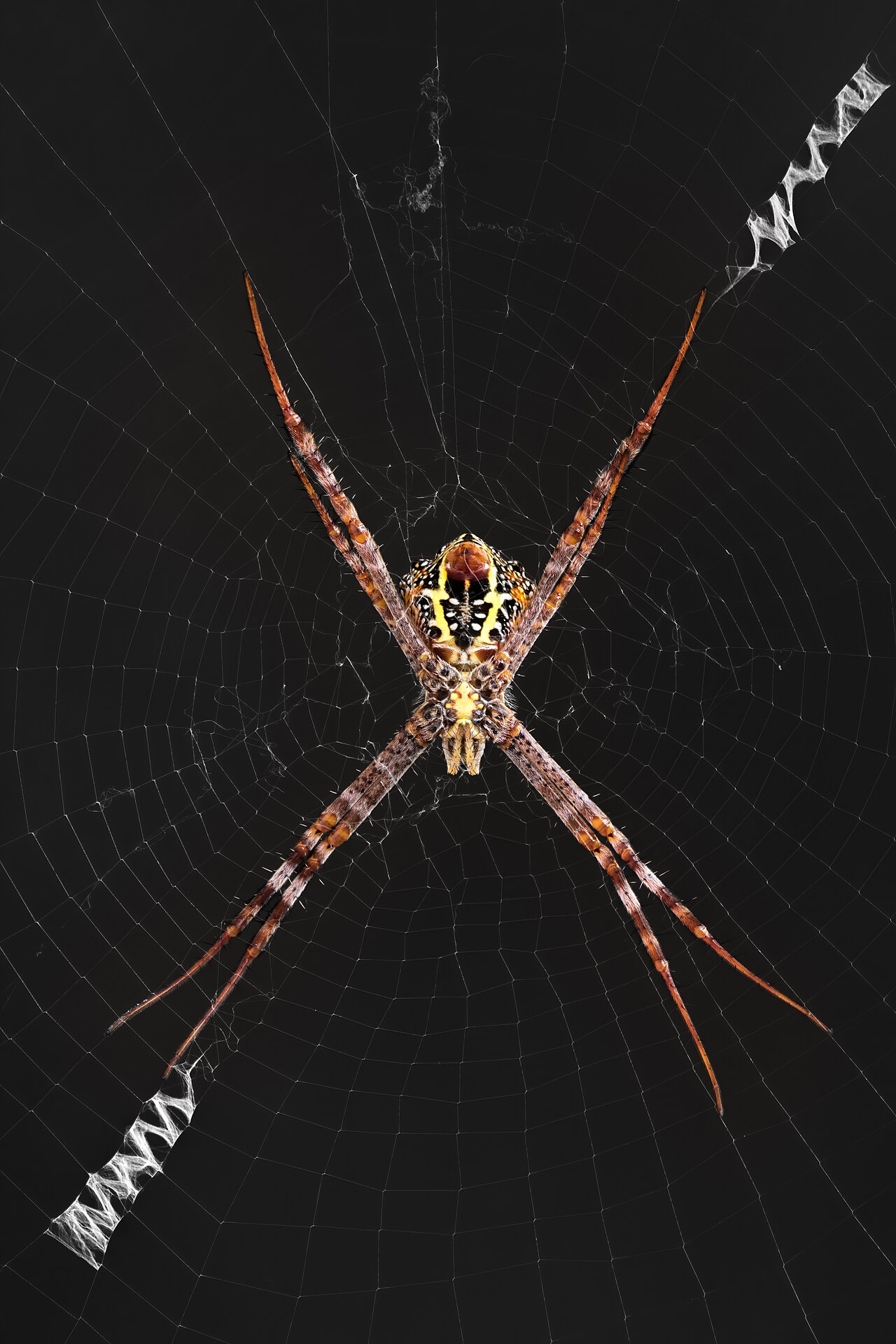
Basile Morin · CC BY-SA 4.0
It serves as one of the game's most iconic threats, embodying the hostile, insect-dominated world the young boy protagonist must traverse. The Spider is not a boss in the traditional sense but a persistent, scripted predator that stalks the player across several screens, requiring careful observation and timing to evade.
- Role
- Recurring enemy / environmental hazard
- Status
- Active (in-game)
Lore & Background
The Spider is one of the earliest and most memorable adversaries in *Limbo*, introduced shortly after the boy enters the dark forest. It is a massive, black arachnid that dwarfs the protagonist, its movements slow and deliberate, yet unnervingly precise. The creature is first seen impaling a smaller spider on a web, establishing its predatory nature and the game's brutal, indifferent ecosystem. Unlike many enemies that can be outrun or avoided, the Spider actively stalks the player across multiple screens, creating a sustained chase sequence that teaches the core survival mechanics of *Limbo*: patience, observation, and trial-and-error problem-solving. The Spider's behavior is governed by simple but effective AI: it patrols set paths, descends from above, and can be temporarily distracted by environmental triggers such as light or moving objects. Its legs are its primary weapons, capable of crushing the boy instantly. The creature is vulnerable only in specific, scripted moments—typically when it becomes trapped in a bear trap or is impaled by a falling log. This vulnerability is not a sign of weakness but a calculated gameplay puzzle, rewarding players who learn its patterns and exploit the environment. In the broader context of *Limbo*'s world, the Spider represents the constant, lurking danger of the forest. It has no backstory or motivation beyond survival and predation, fitting the game's minimalist narrative. Its design—a silhouette of pure black against the gray, foggy backgrounds—makes it a perfect embodiment of the game's monochromatic, oppressive atmosphere. The Spider's presence is a reminder that in this world, the boy is not the hero but simply prey.
In Their Own Story
The boy steps into a clearing. The ground is soft, littered with bones. A shadow passes overhead, and the air thickens with the creak of old silk. He looks up. The Spider is there, motionless, hanging from a thread as thick as his arm. Its legs twitch. He runs. The ground shakes as it drops, each leg striking the earth like a hammer. He ducks under a low branch, hears the snap of wood behind him. The Spider is patient. It does not tire. It simply waits for him to make a mistake. Ahead, a bear trap glints in the dim light — rusted jaws clamped open, hungry. He knows what he must do, but the timing has to be perfect. One wrong step and those legs will find him first.
Reader's Guide
The Spider is a major early-game enemy in *Limbo*, encountered in the forest area shortly after the first puzzle involving a crate and a rope. It is not a boss but a persistent, scripted hazard that chases the player across multiple screens. The Spider's behavior is predictable: it patrols horizontally, descends from above, and attacks by stabbing with its legs. The player must learn to read its pauses — when it lifts a leg, you have a split second to move. Use environmental hazards like bear traps and falling logs to stop it temporarily. The key is patience: rush and you die; wait and watch, and the forest will do the work for you. The Spider can only be killed in specific scripted moments, but it will not respawn once defeated, so take your time and lure it precisely.
Did You Know?
- The Spider is first seen impaling a smaller spider on a web, establishing its predatory nature and the game's brutal ecosystem.
- The creature can be temporarily disabled using environmental hazards like bear traps or falling logs.
- The Spider's legs are its primary weapons, capable of crushing the boy instantly.
- The Spider does not respawn once defeated in its scripted encounter.
- The Spider's design—a pure black silhouette against gray, foggy backgrounds—embodies the game's monochromatic, oppressive atmosphere.
Gameplay Mechanics and Design Philosophy
Limbo distinguishes itself through a unique 'trial and death' design philosophy where failure is an integral part of the learning process rather than a setback to be avoided. Players guide an unnamed boy through a perilous world filled with hidden hazards, from deadly bear traps lurking in the forest floor to mechanical contraptions involving electromagnets and gravity in later stages. The physics system governs how environmental objects interact, allowing players to manipulate their surroundings to solve puzzles, such as using a trap to tear a carcass off a rope to create a climbing path. Deaths are often gruesome, featuring dismemberment or beheading, which serve to steer players away from unworkable solutions, though an optional filter can obscure these visuals on certain platforms. The game offers no limits on restarts at checkpoints, encouraging experimentation within its dark, monochromatic aesthetic where shadows conceal lethal surprises like glowing worms that hijack the player's movement.
Atmosphere and Artistic Presentation
The visual and auditory identity of Limbo is defined by a stark, monochromatic palette that relies heavily on lighting contrasts and film grain effects to evoke an eerie, haunting atmosphere. This minimalist approach strips away unnecessary details, forcing players to navigate through darkness where threats often remain concealed until the last moment. Critics have frequently compared this aesthetic style to classic film noir and German Expressionism, noting how the greyscale graphics enhance the sense of dread and isolation. The soundscape is equally sparse, utilizing minimal ambient noises to heighten tension without overwhelming the player. This deliberate artistic direction led many reviewers to classify the title as a prime example of video games functioning as a legitimate art form, proving that emotional impact can be achieved through atmosphere alone rather than traditional narrative exposition or colorful graphics.
Narrative Structure and Symbolism
The story follows a nameless boy who awakens in a forest described as the 'edge of hell' on a desperate quest to find his missing sister. His journey is marked by surreal encounters, including a massive spider that he temporarily disables before being captured in its web, and a hostile colony of other boys who eventually fall victim to their own traps. The narrative remains intentionally ambiguous; at one point, the boy sees a female figure he believes is his sister but cannot reach her. As the environment shifts from natural forests to crumbling cities and flooded industrial zones, the plot offers no explicit resolution. Upon completing the final puzzle, the protagonist is thrown back into the starting forest only to encounter the girl again just as the screen cuts to black. This open-ended conclusion polarized critics, with some finding deep thematic resonance while others felt the lack of a significant plot detracted from the experience.
Development Origins and Commercial Legacy
Conceived around 2004 by Arnt Jensen, who was then dissatisfied with the corporate environment at IO Interactive, Limbo began as a personal concept sketch that evolved into an art style trailer. This video attracted enough online interest to bring Jensen together with Dino Patti, leading to the founding of Playdead and the full-scale development of the project. Its critical acclaim included numerous industry awards and inclusion on lists of the greatest games of all time. The success of Limbo paved the way for Playdead's subsequent release, Inside, which revisited many of the same dark themes and mechanical puzzles established in this groundbreaking debut.
Gallery





Frequently Asked Questions
Who is Spider?
The Spider is a colossal arachnid antagonist that appears in the early stages of Limbo as a persistent threat. It functions primarily as an environmental hazard rather than a standard boss enemy.
What are Spider's powers or role?
This creature stalks the boy across several screens, requiring players to rely on stealth and precise timing to avoid detection. Its purpose is to instill fear by presenting a predator that cannot be fought directly.
How does Spider's story end?
The encounter concludes once the boy successfully navigates past the Spider's territory without being caught. After this section, the creature does not appear again in subsequent chapters of the game.
Why is Spider important to the game?
It establishes the hostile nature of the forest world and highlights the vulnerability of the protagonist against larger forces. This enemy is widely considered one of the most memorable design elements of the franchise.
Can you kill the Spider?
Players are unable to damage or defeat this enemy using any available weapons or mechanics. Victory comes solely from evasion, hiding in shadows, and waiting for it to move on.
More in Characters
Elsewhere in the Limbo universe
Spotted an error? Know more?
This is a living reference — every entry is fact-audited, and reader corrections feed straight into our audit queue. Suggest an edit · See this site's audit record